- All prices include free UPS ground or USPS Parcel Post shipping. To upgrade your shipping method, click on the upgrade choices to the right. All succulent plants ( except ice plants ) are shipped bare root and can last for weeks in a box with minimal effect, so I do recommend the most cost effective method. If your ordering from East of the Mississippi, I recommend the UPS upgrade. The USPS has choppy service when shipping from here to the Midwest or East coast destinations in rural areas, otherwise their service has been excellent to points westward.
- Occasionally I do have small quantities of certain plants not listed here. Send me an email at the above address to get the list. When I can cover the order request, I'll confirm it with you first and then have you use the generic price buttons below to place the order. Prices, in general, are based on the size of the plant, defined by the following:
4S = 4 inch pot, Smaller plant ( 1-2 inch tall or wide plant ) ..........
4L = 4 inch pot, Larger plant ( 2-3 inch tall or wide plant ) ..........
1G = 1 gallon size ( 3-5 inch tall or wide plant ) ..........
3G = 3 gallon size ( 5-8 inch tall or wide plant ) ..........
5G = 5 gallon size ( 8-12+ inch tall or wide plant ) ..........
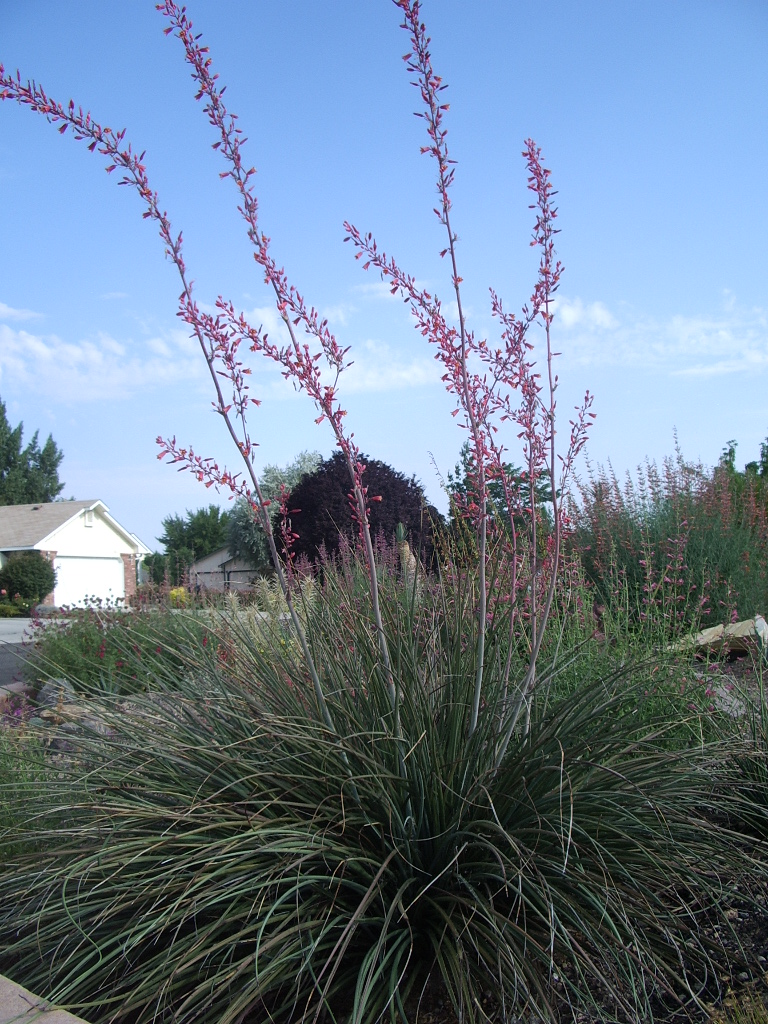
Hesperaloe parviflora GS222.1
"Red Yucca"
Dimensions: 84" H ( with flowers ) x 48" W. Plants form large, yucca like clumps.
Cold Hardiness: USDA Zones 10-5 ( -20 F )
Flowers: Pinkish red with yellow throats on tall flowering spikes up to 7 feet in height. Flowering freely beginning in mid to late Spring until the first hard frost of Fall.
Growth Rate: Clumps expand up to 6 inches per year.
Native Habitat: Primarily the Edwards Plateau of Texas, surrounding states and northern Mexico.
Growers Comments: These plants have proven to be quite adaptable, growing in just about every kind of loose, well drained soil. Fertilizing is not necessary, but can enhance the flowering cycle. Plants are best in full sun and should be watered only if temperatures persist above 90 F for several weeks and only if the plant is actively flowering.
Buying Options: Size 1G plants, shipped bare root, for $9.50 each. Seed packets also available:100 seeds for $3.00. Plant at a depth of 1/4 to 1/2 inch. Seeds germinate between 70-90 degrees F and take 4-6 weeks to sprout. Protect young seedlings the first 1-2 years in cold Winter areas and plant outdoors in mid Spring in the third year.
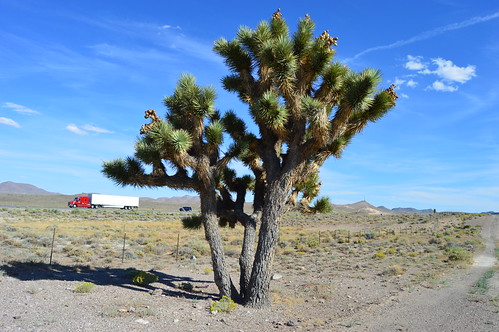
Dimensions: 120"H x 48"W per rosette. Plants are solitary at first, later branching out ( after flowering ) to form small, tree like plants.
Cold Hardiness: USDA Zones 10-6 ( -10 F ), For Zone 6 or colder, plant no later than mid Summer to establish before Winter.
Flowers: White bell flowers on panicles up to three feet, held only half way above the crown in late Spring to early Summer.
Growth Rate: Up to 6 vertical inches per year. Seedlings grow sideways to establish the trunk size ( up to 8 inches in diameter ) for up to 3 years, after which growth becomes vertical. The plant photographed at left is the result of 15-17 years of growth.
Native Habitat: Primarily the Big Bend area of West Texas and adjacent Mexico.
Growers Comments: Probably the most popular garden yucca in the Southwest with it's graceful Palm Tree like appearance. It's flexible leaves are comparatively harmless for people and pets, making it excellent as a feature plant near common areas or driveway entrances. If your in Zone 6 or colder, it's recommended you remove any flower spikes as soon as the petals begin to fall off. This will seal off the rising sap coming up through the spike and allow the plant to recover quicker in time for Winter.
Buying Options: Size 4L plants, shipped bare root, for $7.50 each.
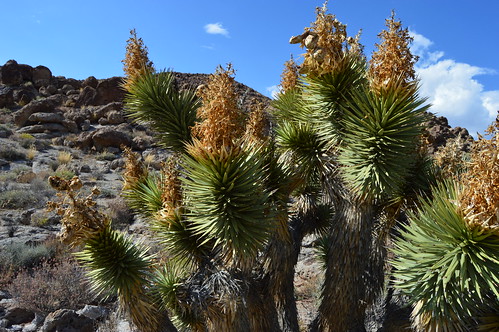
Yucca thompsoniana GS240
"Thompson Yucca"
Dimensions: 120" H x 48" W per rosette. Plants are solitary at first, later branching ( after flowering ) into small, multi branched trees.
Cold Hardiness: USDA Zones 10-6 ( -10 F ). For Zone 6,5 etc. plant no later than mid Summer to establish before Winter.
Flowers: White bell flowers on 4-5 foot panicles, held well above the crown, in late Spring to early Summer.
Growth Rate: Up to 6 vertical inches per year. Seedlings grow sideways to establish the trunk size ( up to 8 inches in diameter ) for up to 3 years, after which growth becomes vertical.
Native Habitat: Big Bend area of West Texas and adjacent Mexico.
Growers Comments: This yucca always gets lots of attention from visitors to the garden. The bright green leaves with yellow margins really make it stand out. In habitat they hybridize with Yucca rostrata and intermediate forms exist, which can make it a challenge to identify some plants in their natural setting, however, in cultivation those differences really stand out and leave no question they're two different plants. Officially, Yucca rostrata and thompsoniana are grouped under a single name ( Y. thompsoniana ), but, in this treatment, they are recognized as separate.
Buying options: Size 4L and size 5G plants, shipped bare root, for $7.50 and $27.50 respectively.
Native to North America, these large rosette succulent plants are popular in Desert garden settings and pair up well with cactus and other succulent plants. The common name "Century Plant" refers to the plants flowering cycle in which the plants energy is stored up over many years as the plant matures and is concentrated into a single flowering spike that lasts for most of the Spring and Summer months. Depending on the variety, this event happens in as little as 10 years on smaller rosette plants and as many as 20 or more years on larger forms. The idea of it taking a century to bloom is misleading and probably relates more to impatient gardeners, where it seems like it takes 100 years to bloom. Sun Exposure: Full to part. All listed species are tolerant of full sun, but do better when given some light afternoon shade. Soil Type: Type 2 soil mixture. Most Agave and Yucca species prefer a slightly richer mix than cactus. Visit the Introduction page for more information on soil types. Watering: Water to establish the first 1-2 years, drying completely between watering in early Spring to early Summer. To harden off for Winter, discontinue any supplementary watering after mid Summer. Pollinators: Hummingbirds and bees. Maintenance: It's recommended to clip the spikes at the end of each leaf to avoid injury if planted near any common area. If your plant flowers, wait until the following Spring to remove the dried rosette to allow the pups to take over. Treat the base of the plant with a systemic every other year to ward off beetle attacks on the root system. This is less critical if your area is far removed from the Agave plants natural range. Invasive Properties: Low to none. Traditional, Culinary, or Medicinal Properties: Tequila and Mescal are common alcoholic beverages derived from Agave plants. In addition Agave Honey ( sometimes called Agave Nectar ) has become popular as a healthy alternative to bee honey or sugar due to it's low glycemic rating.
Hesperaloe
Native to North America, these yucca relatives have been popular as landscape plants in the desert southwest and, more recently, been tried in colder climates further North and East. Hesperaloe parviflora is the most widely used plant as it continues to survive and even thrive in much colder areas than expected, such as Denver, Colorado, and even here in SW Idaho, where plants have set seed, sprouted and matured to flowering size with no protection. Most species occur in central and northern Mexico and are not very cold hardy, so their use is more limited in colder areas. Hesperaloe funifera barely comes into South Texas, near Del Rio and has potential in colder areas in protected sites. What makes these plants so appealing, in the case of Hesperaloe parviflora, is the long lasting flowers ( typically all Summer ) that attract hummingbirds with their pale to deep red tubular flowers. Chance flower colors have emerged in mass plantings and have lead to such cultivators as "Yellow Hesperaloe" with yellow flowers and, more recently, the deep red flowering "Brakelights" from the folks at Mountain States Wholesale in Glendale, Arizona. In addition, Hesperaloe parviflora and funifera are actively being crossed by researchers, including myself, to increase the color palette even further, so I suspect you'll see just about every flower color in a few years. Sun Exposure: Full sun. All species do well in full sun, but do tolerate some shade. Avoid shady or dark areas of the landscape. Soil Type: Type 2 soil mixture. Plants do best in slightly richer soil mixture. Visit the Introduction page for more information on soil types. Watering: In dry, hot climates it's recommended plants be watered every two weeks ( usually from a drip line, or hand watering works fine ) to maintain flowering through hot spells during the hottest months, from late June, and all of July and August. Discontinue in September as flowering spikes mature and the temperatures cool. Pollinators: Hummingbirds and bees. The tall flowering spikes are hummingbird magnets. Maintenance: To keep plants looking their best, once a year, preferably in the Spring, remove older leaves as they dry out and begin to lay flat. They should come out with a light tug, otherwise you can use pruning sheers and cut as low to the ground as you can. Invasive Properties: Low to medium. Plants are heavy seeders and can spread into open, sandy areas. Traditional, Culinary, or Medicinal Properties: None recorded, but it's not to hard to imagine the bulbous roots were used for some purpose.
Yucca
Species of Yucca are native to North America and occur in a diverse number of habitats, both wet and dry. Plants are rosette forming in youth and can mature into palm like trees, dense clumps, or a combination of the two. The species listed here are arid adapted species from the desert southwest and require little, if any, supplementary watering once established. Yuccas are great in the landscape and can be feature plants or used as contrast to other plants in the landscape. Their evergreen nature is best appreciated during the Winter months when most other plants have done dormant and lost their foliage. For this reason they are best used near entryways or other common areas to maintain a nice green look throughout the year. Sun Exposure: All listed species do best in full sun. Avoid shady or dark areas of the landscape. Soil Type: Use soil type 2. Most species do best in a slightly richer mix. Visit the Introduction page for more information on soil types. Watering: For listed species, water only to establish the first 1-2 years, drying completely between watering, after which watering is not necessary, except in cases of severe drought or prolonged heat. Pollinators: Yucca moth. Yuccas have a unique relationship with certain months that pollinate them in their native habitat. The moths lay their eggs at the base of the flower, with their larvae consuming most, but not all, of the developing seed pod, which leaves just enough seeds for the plant to successfully reproduce. Maintenance: Once a year, usually in early Spring, remove older leaves as they dry out with sharp pruning sheers. This is more important with the trunk forming species in order to enhance the palm like appearance and minimize bugs that like to hide in the thatch. Red spider can sometimes be a problem on new growth or newly transplanted plants, so I recommend inspecting once a month. In most cases, red spider can be washed off with spray from your garden hose. If they persist or get worse, you can use a systemic around the base. Invasive Properties: Low to none. Traditional, Culinary, or Medicinal Properties: Yuccas have many traditional uses. The two most commonly known are where leaves are used in basket weaving and roots of some species are used in soap making.
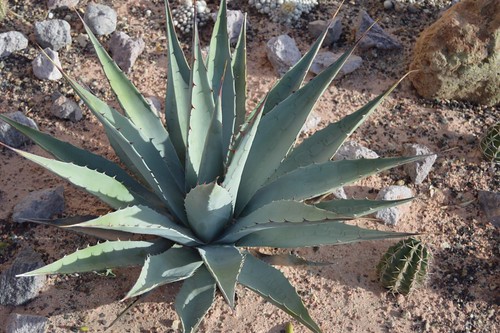
Agave havardiana GS202
"Havards Century Plant", "Chisos Century Plant", "Big Bend Century Plant"
Dimensions: 36" H x 48" W per single rosette. Pups can emerge up to 8 or more feet away from the original rosette.
Cold Hardiness: USDA zones 9-6 ( -10 F )
Flowers: Spikes up to 15 feet with yellow green tubular flowers. The main rosette dies after flowering and the pups take over.
Growth Rate: Up to 6 inches per year.
Native Habitat: Primarily the Big Bend area of West Texas.
Comments: This is the largest of the cold hardy Agaves yet tested with individual plants approaching four feet in diameter.
Buying Options: 3G sized plants, shipped bare root, for $17.50 each.
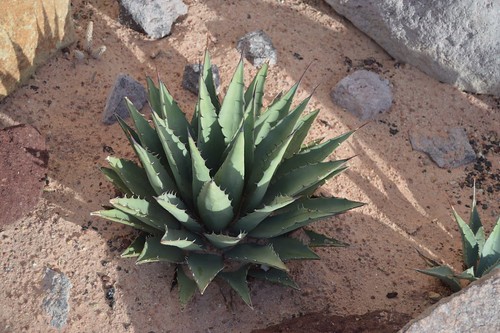
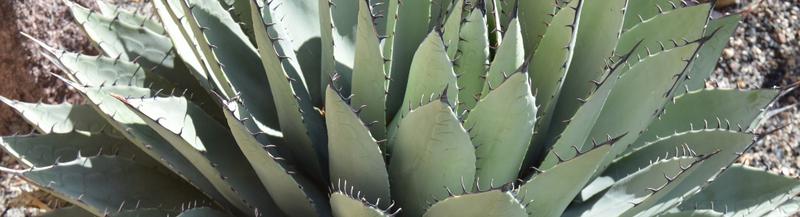
Agave parryi GS205
"Parry's Agave"
Dimensions: 24"H x 36" W per rosette. Pups can emerge up to 6 feet away from the original rosette.
Cold Hardiness: USDA zones 9-6 ( -10 F )
Flowers: Spikes up to 12 feet with yellow green tubular flowers. The main rosette dies after flowering and the pups take over.
Growth Rate: Up to 4 inches per year.
Native Habitat: Widespread in the southwestern USA and northern Mexico at elevations above 4000 feet in Oak or Pine woodlands on rocky exposures or ridges. This the northern most form from the Flagstaff, Arizona area at near 7000 feet.
Growers Comments: These are powder grayish blue rosettes with black teeth up to 1/4 inch long. This batch selected from seedlings with the longest teeth characteristic.
Buying Options: Size 1G plants, shipped bare root, for $9.50 each.
Agave parryi var. neomexicana GS207
"New Mexico Agave", "Mescal Agave"
Dimensions: 20" H X 30" W per rosette. Pups can emerge up to 4 feet away from the original rosette.
Cold Hardiness: USDA zones 9-5 ( -20 F )
Flowers: Spikes up to 12 feet with yellow green tubular flowers. The main rosette dies after flowering and the pups take over
Growth Rate: Up to 4 inches per year.
Native Habitat: New Mexico.
Comments: This variation of Agave parryi is a little smaller in size and appears to be slightly more cold hardy.
Buying Options: Size 1G plants, shipped bare root, for $9.50 each.
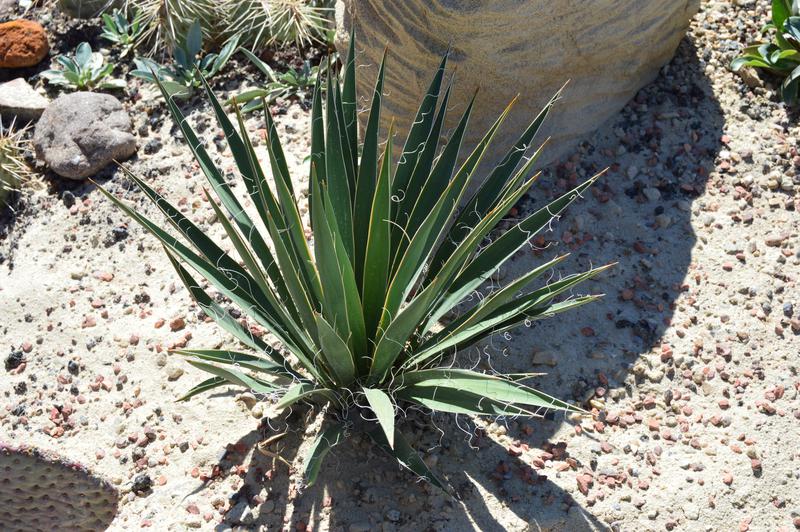
Dimensions: 48" H x 36" W per rosette. Plants can form short trunks and branch after flowering. Suckers can emerge around the base, but are few and non aggressive. For this yucca, I recommend removing any suckers if they appear.
Cold Hardiness: USDA zones 9-5 ( -20 F )
Flowers: Panicles of purple tinted white bell flowers up four feet above the foliage in mid to late Spring.
Growth Rate: Up to three vertical inches per year.
Native Habitat: Southern Utah and northern Arizona, in both sandy or rocky habitats.
Growers Comments: Plants are highly variable as they hybridize with other yucca species. This form produces short trunks and has attractive blue green leaves.
Buying options: Size 1G plants, shipped bare root, for $9.50 each.
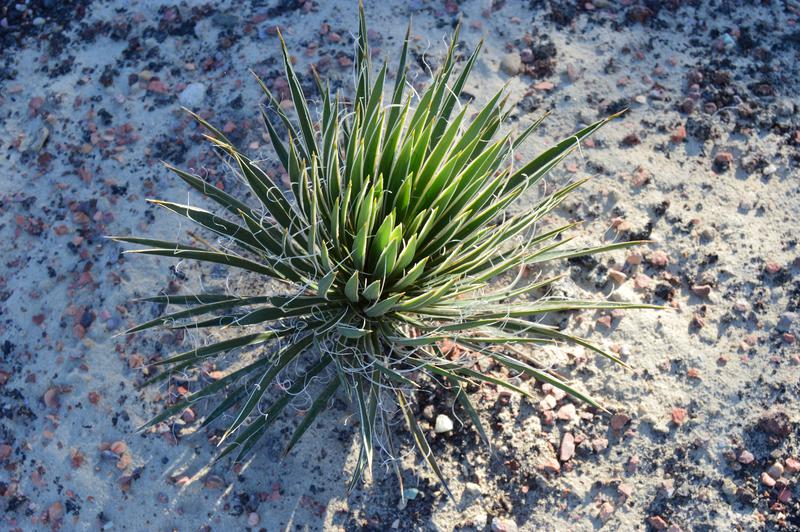
Yucca nana GS237
"Dwarf Yucca"
Dimensions: 24"H x 10" W per rosette. Plants are solitary at first. later branching ( after flowering ) and, or suckering to form dense, rounded mounds up to 4 feet or more across. Small plants superficially resemble Agave toumeyana.
Sun Exposure: Full Sun.
Cold Hardiness: USDA zones 9-5 ( -20 F ), Probably colder.
Flowers: Spikes of purple tinted white bell flowers up three feet above the foliage in mid to late Spring.
Growth Rate: Up to three inches per year.
Native Habitat: Four Corners area of Utah, Colorado, New Mexico, and Arizona.
Growers Comments: Plants are highly variable as they hybridize with other yucca species. This form with small rosettes no larger than 10 inches across and generous amounts of hair on the leaf margins.
Buying options: Size 1G plants,shipped bare root for $9.50 each.
Hybrid Red Yucca ( Hesperaloe parviflora x funifera )
Thompson's Yucca ( Yucca thompsoniana )
Hesperaloe parviflora x funifera GS223
"Hybrid Red Yucca"
Dimensions: 108" H ( with flowers ) x 48" W. Plants form large, yucca like clumps.
Cold Hardiness: USDA Zones 10-6 ( -10 F ), Plants are slightly less hardy than the true strain of Hesperaloe parviflora.
Flowers: Variable in color and size. So far, pink, red, orange, or yellow on tall flowering spikes up to 9 feet in height have been recorded. The flowering doesn't last as long on these hybrid plants, but the spikes are taller and broader in size. This is more characteristic of Hesperaloe funifera, which has taller spikes, but a shorter flowering cycle than Hesperaloe parviflora.
Growth Rate: Clumps grow up to 6 inches per year.
Native Habitat: Garden origin.
Growers Comments: These hybrid plants have numerous intermediate characteristics on both flowers and leaves. Some plants have leaves that have dense hairs on the margins, while others have smooth edges. Leaf color can be purplish, grayish, deep or bright green. No two plants exactly alike. Most test plants have not flowered yet, so it's highly probable more colors will be observed. Seeds offered below are from orange or pink flowering plants.
Buying Options: Seed: 50 seed for $5.00. Sowing instructions: Plant at a depth of 1/4 to 1/2 inch. Seeds germinate between 70-90 degrees F and take 4-6 weeks to sprout.
2012 is the year of the Agave! I have several 1 gallon sized batches of plants this year that are the ideal size for transplanting as well as two new listings. By mid to late Summer, I should have the first release of plants of the hybrid Hesperaloe parviflora x funifera hybrid as well as new listings for Yucca elata and it's rare cousins var. utahensis and var. verdiensis.
Preserving Nature: No field collected plants are sold here. Only cuttings from garden cultivated plants or seedlings grown from garden or wild collected seeds from reputable sellers. In rare cases, I'll sell salvage plants from urban development projects, where the plants would have been destroyed otherwise. Preservation is my number one priority!
Buying Tips: When purchasing, a PayPal window will open as your shopping cart. I recommend keeping the window open ( do not close or use the "Return to shopping" button ), otherwise you'll have to push another buy button to view the cart. You do not have to have a PayPay account to purchase as it only handles the transaction. If you wish to buy the old fashioned way via snail mail, that's ok too. Send me a list ( please include the GS numbers ) and your check or money order made out to Geoscape. Only USA orders are accepted at this time.
Blue Bananna Yucca ( Yucca baccata var. vespertina ) and Pancake Prickly Pear" ( Opuntia chloritica ) in habitat in the Virgin River Canyon, SW Utah.
Agave parryi var. cousei GS206New for 2012!
"Smooth Leaf Parrys Agave"
Dimensions: 24" H x 36" W per rosette. Pups can emerge up to 6 feet away from the original rosette.
Cold Hardiness: USDA Zones 9-6 ( -10 F )
Flowers: Spikes up to 12 feet with yellow green tubular flowers. The main rosette dies after flowering and the pups take over.
Growth Rate: Up to 4 inches per year.
Native Habitat: In isolated populations near Sedona, Arizona.
Growers Comments: This is a localized form of parryi with very short teeth on the leaf margins, with some being almost spineless. This batch selected from seedlings with the fewest teeth.
Buying Options: 1G size plants, shipped bare root, for $9.50 each.
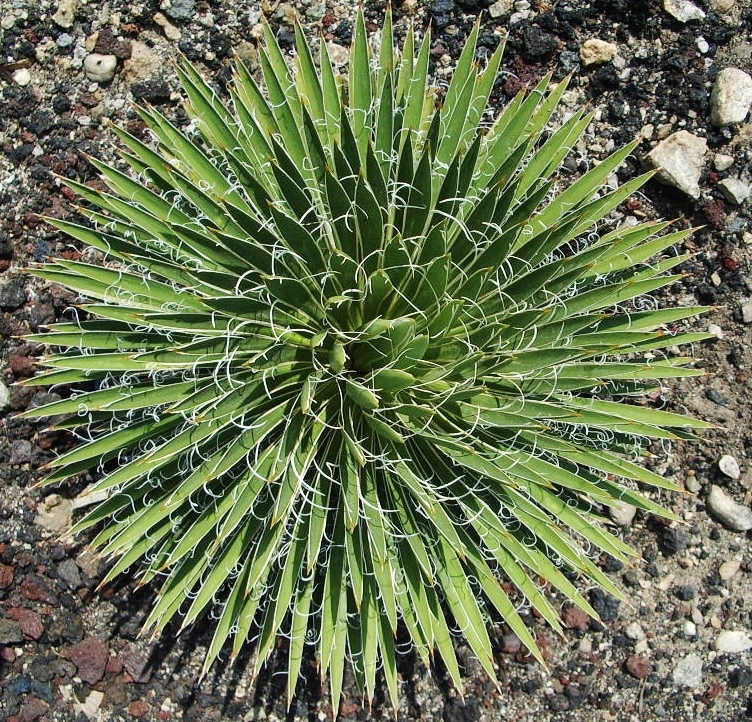
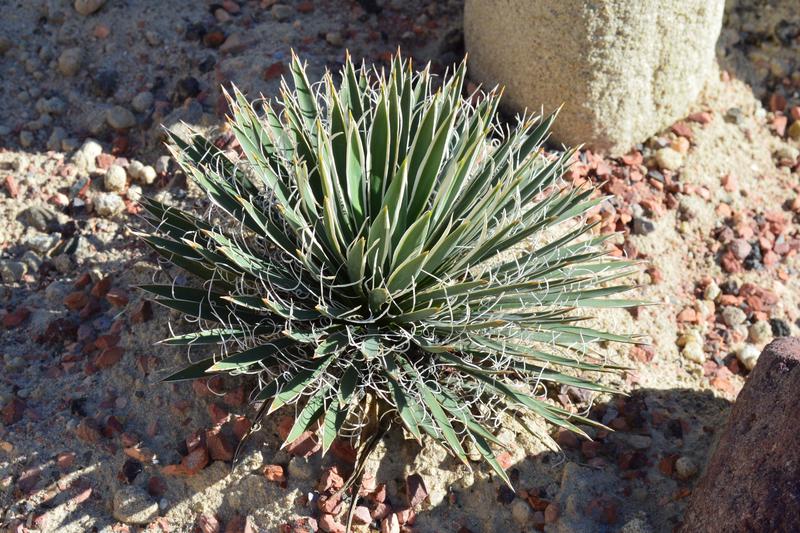
Agave toumeyana ssp. bella GS208New for 2012!
"Toumeys Agave", "Miniature Century Plant"
Dimensions: 8" H x 10 W per rosette, however this Agave suckers freely, forming dense colonies up to 4 feet or more across.
Cold Hardiness: USDA Zones 9-6 ( -10 F )
Flowers: Spikes up to 6 feet or more in height with yellow green tubular flowers beginning in mid to late Spring and lasting into mid Summer. The smaller stature of this Agave allows it to mature much quicker than their larger counterparts and can flower in as little as 7 years from seed. Flowering rosettes die off after flowering and the numerous pups take over.
Growth Rate: Up to 2 inches per year.
Native Habitat: Central Arizona in oak or pine woodlands in rocky outcroppings or ridges.
Growers Comments: This is a nice miniature Agave that has turned out to be quite hardy. From seed, I lost several of these in the Winter in the first one to two years, but by the third year they seem to mature enough to endure severe frost and I didn't loose any more. These are four year old seedling plants as shown in the picture to the left.
Buying Options: Size 1G plants, shipped bare root, for $9.50 each.
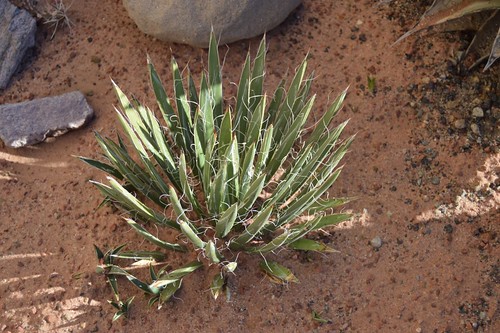
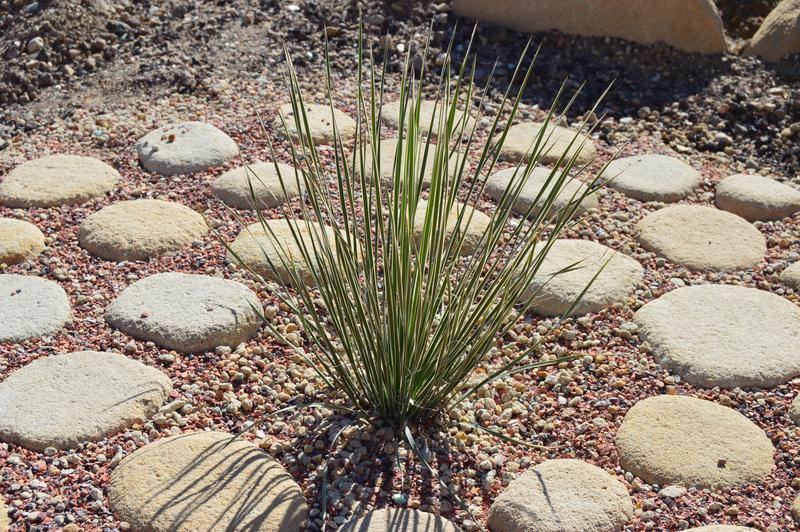
Yucca angustissima var. kanabensis GS232.1 New for 2012!
"Narrowleaf Yucca"
Dimensions: 72"H x 48" W per rosette. Plants sucker to form small colonies up to 10 feet or more wide, so give this one plenty of space. In habitat, they look like a miniature forest of tall, narrow yuccas.
Cold Hardiness: USDA Zones 9-5 ( -20 F )
Flowers: The tall panicles are up to 6 feet above the rosette and are purple blushed, white bell, waxy flowers in mid to late Spring. Spectacular when in bloom.
Growth Rate: Individual trunks can grow up to 3 inches or more per year.
Native Habitat: Southern Utah and northern Arizona, growing mostly in pure sand.
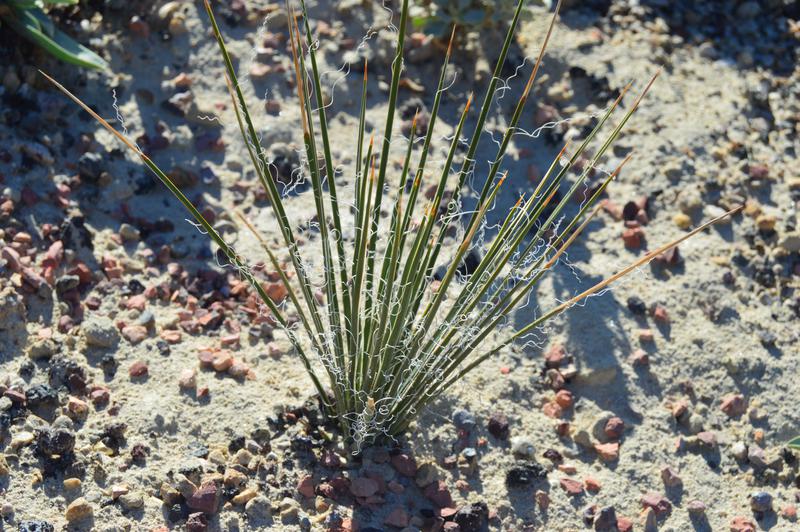
Growers Comments: Small plants, like the one in the photo to the left, can easily resemble yucca elata until they mature and their distinctive characteristics emerge, that being smaller trunks to only about three inches wide and more aggressive suckering habit. In addition, they to not typically branch after flowering and remain as solitary rosettes, where this is common in yucca elata.
Buying Options: Size 1G plants, shipped bare root for $9.50 each.